Training under the Sun and How to Protect Your Skin
For many of us, being able to exercise and spend time outdoors in the sunshine feels energising and exciting—especially after cold, dark, and damp winter months. However, excessive exposure to sunlight, particularly the ultraviolet radiation component, can damage our skin. Therefore, as athletes who prefer to train outside when possible, we all need to be aware of the risks of overexposure to the sun and learn how to minimise potential harm to our skin.
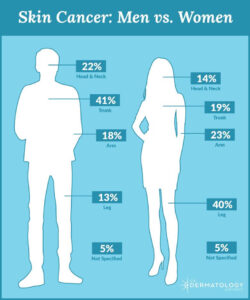
A recent skin cancer diagnosis has made this very real for me from a personal perspective. This spring, I noticed an unusual spot on my shin—a dry lump I initially thought was a skin tag, assuming it was just a natural part of aging. However, after a few weeks and some advice from my family, I saw a dermatologist for a professional opinion. I’m glad I did because the strange lump turned out to be a small skin cancer—squamous cell carcinoma. Luckily, it was easy to treat in the dermatology office (thanks, lidocaine!), and because it was caught early, the risk of further issues is very low. The dermatologist informed me that women are more likely to develop skin cancers on their lower legs and arms, whilst men more often find skin cancer on their torso and head, which is worth considering (see infographic below) – especially when applying sunscreen and covering up.
In a similar situation, Georgie also found out she had skin cancer five years ago, diagnosed as melanoma. More challenging to treat, Georgie had surgery to completely remove the melanoma, which luckily did not need any extra treatment. However, the side effects from her surgery included lymphedema, which was very painful and uncomfortable for Georgie, as you can imagine.
After talking with my dermatologist, I realised that over the past year or so, I’ve been making some mistakes in how and when I go outside to run. I’ve made some changes to when I train and am sharing the main points of what I’ve learnt below, based on the advice I received from the dermatologist. I’m writing this now because I believe we can all benefit from taking care of our skin while also enjoying time outside in the sun.
- Check the UV Index* before you train/ run or exercise outside. Ideally, spend time outdoors when the UV Index is low (0-2), or limit your hours in the sunshine and cover up when the UV Index is moderate (3-7). Ideally avoid training outside for extended periods when the UV Index is high (8-11). This can be unavoidable in long races, where the following points about sunscreen use will be most important.
- Apply sunscreen to all exposed skin surfaces (including your shins, ahem).
- Reapply sunscreen after two hours – it wears off with sweat. You can also use something such as SpotMyUV to tell you when to reapply sunscreen.
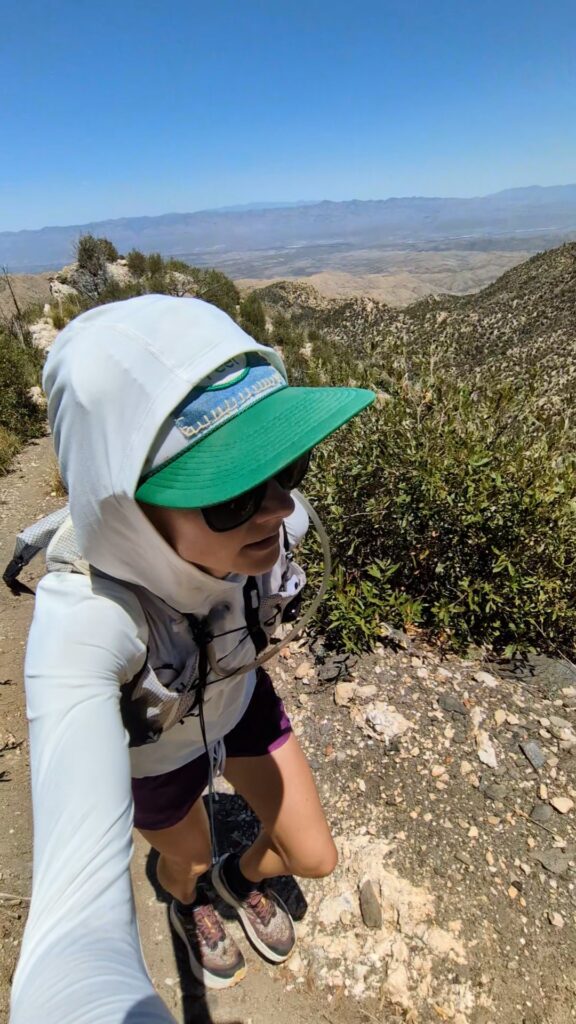
- Wear UPF sun protection clothing and a hat. There are many excellent ‘Ultraviolet Protection Factor’ clothing options available now (the higher the number the more protection the clothing offer e.g. UPF50+ equates to 2% of the sun’s UV radiation being blocked). I’ve been wearing a sun protection top from Mountain Hardwear for long runs when it’s impossible to avoid moderate UV, and I’ve found it to be surprisingly comfortable, lightweight, and breathable (not at all what I expected, which was extra hot & sweaty). Rabbit and Patagonia also have lines of UPF outdoor clothing.
- Use sunglasses with UV protection. Look for the UV400 label or 100% UV proteection and choose polarised or polycarbonate lenses that block UV rays.
A note on sunscreen! Here are a few considerations:
- Choose a Broad-Spectrum sunscreen that covers both UVA and UVB radiation.
- Use at least SPF 30.
- Look for a water-resistant sunscreen that will stay put for longer, noting that no sunscreen is fully waterproof.
- Apply sunscreen about 15 minutes before going outside.
- Adults should apply approximately 1 oz, or a shot-sized glass amount of sunscreen to the body, and a teaspoon-sized amount to the face.
- Mineral sunscreens contain zinc oxide and titanium dioxide to create a physical barrier that deflects radiation. Non-nano sunscreens use zinc particles larger than 100 nanometers and are less likely to be absorbed into the skin. Mineral sunscreens are also better suited for sensitive skin.
- Chemical sunscreens absorb the sun’s rays.
- Consider avoiding ingredients such as oxybenzone and octinoxate. These chemicals are especially harmful to coral reefs and the environment, and are banned as ingredients of sunscreen in Hawaii.
There are lots of brands of sunscreen available, and these are a few we’ve tried and tested with success so far:
- Badger Adventure Mineral Sport SPF 50 (metal tin) and SPF 15 lip balm (used on my face & lips in Cocodona).
- Banana Boat Sport Ultra Spray SPF 100 (used on my legs in Cocodona 250).
- Attitude Living Mineral Sunscreen Stick for Sensitive Skin SPF 30 (cardboard packaging).
- Tanri Mineral Sunscreen SPF 30.
- Hawaiian Tropic Skin Defense Lotion SPF 50.
- Husk and Seed – UK-based botanical skincare company.
- EltaMD UV Sport Broad Spectrum SPF50 (LRC athlete Leah, based in California, uses this on her face because it doesn’t run with sweat and it was also recommended by my dermatologist).
- Neutrogena Sport Active Defense products.
- Sunbum sunscreen products for face, lips & body.
Overall, as athletes, we need to consider our epidermis as much as we think about muscles, tendons, and bones when we head outside to run, bike, or swim. Sunshine is not something to avoid, but embrace, and just like most things in life, enjoy in moderation. And to quote Baz Luhrmann, by way of the writer Mary Schmich:
“If I could offer you only one tip for the future, sunscreen would be it
The long-term benefits of sunscreen have been proven by scientists.”
Thanks for reading, Susie.
*The UV Index measures the strength of the sun’s ultraviolet radiation. On a scale of 0 to 11+, with the higher numbers indicating stronger UV radiation.
References:
“What doctors wish patients knew about wearing sunscreen.” https://www.ama-assn.org/delivering-care/chronic-diseases/what-doctors-wish-patients-knew-about-wearing-sunscreen
“The science of sunscreen.” Harvard Health Publishing. https://www.health.harvard.edu/staying-healthy/the-science-of-sunscreen
“Skin Cancer: Men versus Women.” https://www.usdermatologypartners.com/blog/skin-cancer-men-vs-women/