Every month at LRC we choose a word to sit with, on the mat, in training, in life. This month, after a weekend that asked more of my heart than my legs, our word is honour, and it started with a question with a question we asked ourselves – can you race when you’re ill?
Where it started: Ahimsa on the mat
Susie teaches our weekly yoga class and this week she explored the word ahimsa, the yoga principle of non-harming. It’s interpreted many ways, but for athletes, we think it comes down to this: listening to your body, knowing when to train hard and when to back off, and practising self-love and acceptance rather than punishment.
In Arizona, where Susie is based, that’s meant adapting to monsoon season, learning to slow down, hydrate, and let go of pace goals that made sense in cooler months, because ahimsa, in that context, is simple: respect the conditions, respect the body.
But this week, ahimsa asked a harder question.
Darlington 10K: a hometown race, a head versus heart decision
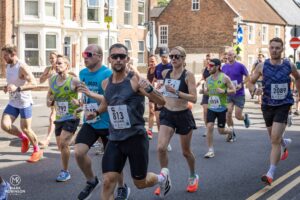
Sunday was the Darlington 10K, part of the town’s growing running festival that now includes a family fun run, a junior 3K, a 5K, and the 10K, with 1,700+ runners taking part this year alone. Darlington is where my sister Susie and I grew up, so this race has always been more than a number on a bib.
I woke up race week with a tight chest and a lingering cough, not fighting fit by any measure, and if it had been any other race, I’d have sat it out without a second thought but my heart had other ideas.
This wasn’t just about a finish time, it was about remembering how fortunate I am to be able to line up at all. For a few years, through illness, and then postpartum, I wasn’t strong enough, or well enough to start a race, let alone finish one, so standing on that start line felt like something I couldn’t let a tight chest or cough take from me.
Running for more than yourself
This year’s race numbers carried #BeMoreGary, in memory of Gary Read, a much loved figure in the Darlington running community, known for the encouragement he gave to everyone around him on a run. That spirit was everywhere on the course, and the crowd support in this race is unlike anything else in a 10K, so on a day I wasn’t at my strongest, it carried me round.
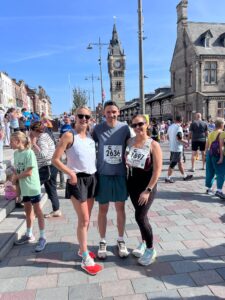
I didn’t run the time I trained for, but I did finish 1st in my age group and 3rd team for Darlington Harriers, which was a bonus.
Word of the month – honour
What I decided about racing whilst not feeling 100% was honouring something bigger: the privilege of being able to run at all, the town that raised me, and being out on the course with fellow LRC athletes and representing Harriers. Sometimes showing up, imperfectly, is the most honouring thing you can do.
So this month, our word is Honour. Not every decision needs your head and heart to agree, sometimes the practice is choosing which one to listen to, and making peace with that choice afterwards.
So, can you race when you’re ill?
You know your body best, and that’s really the honest answer. If you’re bedbound, dehydrated, running a fever, or haven’t been able to eat or drink properly, it’s not advisable to race, no matter how much your heart wants to. That’s your body asking for rest, and pushing through it isn’t honouring anything.
But if you’ve got energy, you’re prepared to revise your pace, let go of a top performance, and you’re running for a different reason than the clock, it’s often a different story. Here’s what we’d weigh up before deciding:
- Where are your symptoms? As a general rule, symptoms above the neck (a mild cough, a blocked nose, a scratchy throat) are usually more manageable than symptoms below the neck (chest tightness, body aches, a upset stomach).
- Are you eating and drinking normally? If you can’t keep food or fluids down, or you’re already dehydrated, your body doesn’t have what it needs to race safely.
- Do you have a fever? A raised temperature is one of the clearer signs to sit a race out, since it means your body is already working hard to fight something off.
- Can you let go of the outcome? If you’re only willing to race for a PB or a top finish, illness isn’t the day for it. If you can go in prepared to slow down and adjust, that’s a different mindset entirely.
- Do you have a plan to stop? Know your exit point before you start. Be honest with yourself, start and stop if things get worse rather than pushing through.
This isn’t medical advice, and if you’re at all unsure, a quick check with a GP beforehand is always worth it but for us, that Sunday, the answer was yes, carefully, and for the right reasons.
This month, we invite you to ask
- What are you honouring when you show up, even when it’s not your strongest day?
- Where in your training could you stand to listen more, and where might honouring your heart matter more than the plan?
- Who or what are you carrying with you when you toe the line?